
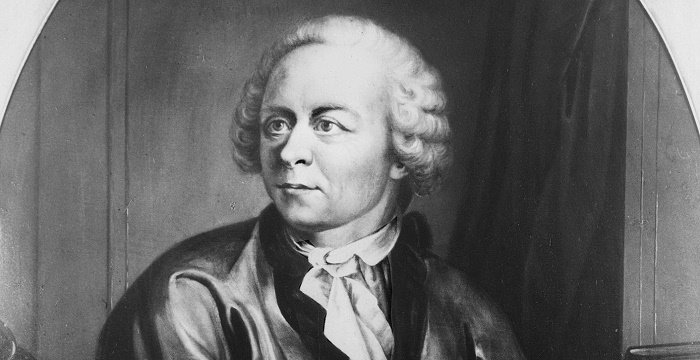
Most of us are familiar with the mathematical constant $e \approx 2.71828$. We see it in natural logarithms ($\ln e = 1$) and calculus ($\frac{d}{dx} e^x = e^x$). This "Euler’s Number" is named after the legendary 18th-century mathematician Leonhard Euler.
Euler was a pioneer of theoretical mathematics, publishing over 500 research papers. He introduced symbols we use every day, such as $\pi$ for pi, $i$ for the imaginary unit $\sqrt{-1}$, and $\Sigma$ for summation. Among his many contributions, the Königsberg Bridge Problem stands out as one of the most fascinating stories in mathematical history.
The Riddle of Königsberg
Born in 1707 in Basel, Switzerland, Euler was a student of the famous Johann Bernoulli. While working at the St. Petersburg Academy of Sciences, he received a letter regarding a puzzle from the city of Königsberg (then in Prussia).
The city was divided into four landmasses by the Pregel River: two main banks and two islands. These four areas were connected by seven bridges. The townspeople often wondered: Is it possible to take a walk through the city, crossing every bridge exactly once and returning to the starting point (or ending elsewhere) without repeating a bridge?
The Challenge: Look at the map of Königsberg. Can you find a route that crosses all seven bridges without crossing any bridge twice?
The Birth of Graph Theory
For a long time, people struggled to solve this. At first, Euler didn't think it was a "mathematical" problem. However, he eventually realized that the physical distance between bridges didn't matter—only how they were connected.
To solve it, Euler simplified the map into a diagram of points and lines:
Nodes (Vertices): The four landmasses (A, B, C, and D).
Edges: The seven bridges connecting them.
This was the beginning of Graph Theory. Unlike the bar charts or line graphs we see in business, this "Graph" is a network of connections.
Why It Was Impossible
Euler discovered that for a path to exist where you cross every edge exactly once (an Eulerian Path), the number of edges connected to a node (called its Degree) must follow specific rules:
To start and end at different points: Exactly two nodes must have an odd degree (the start and end points), and all others must be even.
To start and end at the same point (Eulerian Circuit): All nodes must have an even degree.
In Königsberg, the nodes had degrees of 5, 3, 3, and 3. Since all four nodes were odd, the puzzle was mathematically impossible to solve.
How Graph Theory Shapes Our World Today
While it started as a simple riddle, Graph Theory is now a cornerstone of modern technology. We use it for:
Google Maps: Finding the shortest route between two locations.
Computer Science: Designing algorithms and data structures.
Electrical Engineering: Designing and solving complex circuit layouts.
Social Networks: Analyzing connections between millions of people on platforms like Facebook or LinkedIn.
Science: Understanding molecular structures and 3D simulations.
The Legacy of Euler
The city of Königsberg was sadly destroyed during World War II and is now known as Kaliningrad, Russia. However, its name lives on in every math textbook.
Euler continued his research until the very end, even after losing his eyesight. He passed away in 1783, but his honors continue:
The Euler Medal: Awarded for excellence in research.
Asteroid 2002 Euler: Named in his honor in 1973.
The story of the seven bridges teaches us that even a casual coffee-house riddle can lead to a scientific revolution that changes human civilization forever.